Home / Foundation Repair
Foundation Repair in Kansas City, KS
Cracks in the walls, doors that stick, floors that slope, a foundation that looks like it is moving. We inspect the problem, tell you what is causing it, and walk you through the repair options in plain language.
Common foundation problems we see in Kansas City homes
Most foundation problems in this area come back to the same few causes: expansive clay soil that swells when wet and shrinks when dry, poor drainage that keeps water against the foundation, and the freeze-thaw cycles we get every winter. Here is what that looks like inside a home.
Cracks in foundation and basement walls
Vertical, diagonal, and stair-step cracks in poured concrete or block. Some are cosmetic. Cracks that are wider at one end, wider than about 1/8 inch, or leaking water usually are not.
Horizontal cracks and bowing walls
A horizontal crack partway up a basement wall, or a wall leaning in at the top or bulging in the middle, points to pressure from the soil outside. Look at this one sooner rather than later.
Foundation settlement
One part of the house sinking lower than the rest. You see it as drywall cracks above doorways, gaps between the wall and the ceiling or floor, and brick cracks that step down along the mortar.
Uneven, sloping, or bouncy floors
Floors that dip toward the center or a corner of the house, or a spot that flexes when you walk over it. Often tied to settlement or crawl space support that has shifted.
Doors and windows that suddenly stick
Interior doors that used to close fine and now catch, or windows that will not open. When the frame moves, the opening goes out of square.
Gaps around doors, windows, and trim
Daylight under an exterior door, caulk lines that keep splitting, or trim pulling away from the wall. Small movements add up over a few seasons.
Seeing one or two of these does not automatically mean a major repair. It means it is worth having someone look. An inspection tells you whether the movement is active and how far it has gone.
Signs you may need foundation repair
Run through this list. If more than a couple sound familiar, or if anything is getting worse month to month, that is the signal to book an inspection.
- Cracks in drywall that keep coming back after you patch them, especially above doors and windows
- Exterior brick or block cracks that run in a stair-step pattern along the mortar
- A basement or crawl space wall that is bowing, leaning, or has a horizontal crack
- Floors that slope, sag toward the middle, or feel bouncy in one area
- Doors and windows that stick, or gaps opening at the top corners of door frames
- Gaps between the foundation and the porch, steps, chimney, or garage floor
- Water coming in through a floor or wall crack after heavy rain
- A chimney that is tilting away from the house
Cracks alone are common in Kansas City. The pattern, the width, and whether they are still moving are what matter. We measure and document all of that during the inspection so you have a baseline.
Start with a real inspection
Before anyone talks about piers or price, someone needs to look at the house. During a foundation inspection we check the inside and outside of the foundation, the basement or crawl space, the grading and drainage around the house, and the doors, windows, and floors for signs of movement.
You get a clear explanation of what we found, what is likely causing it, whether it is still active, and what your options are. If the problem is minor or cosmetic, we will tell you that.
Foundation and basement wall crack repair
Not every crack is repaired the same way. A non-structural crack that is letting in water is usually sealed from the inside with a flexible polyurethane or epoxy injection that fills the full depth of the wall. A crack that is part of a larger movement problem needs that movement addressed first, or it will just open back up.
We look at width, direction, location, and whether the two sides of the crack are offset. That tells us whether you are dealing with a seal-it-and-done repair or something structural.
Settlement and sinking repair
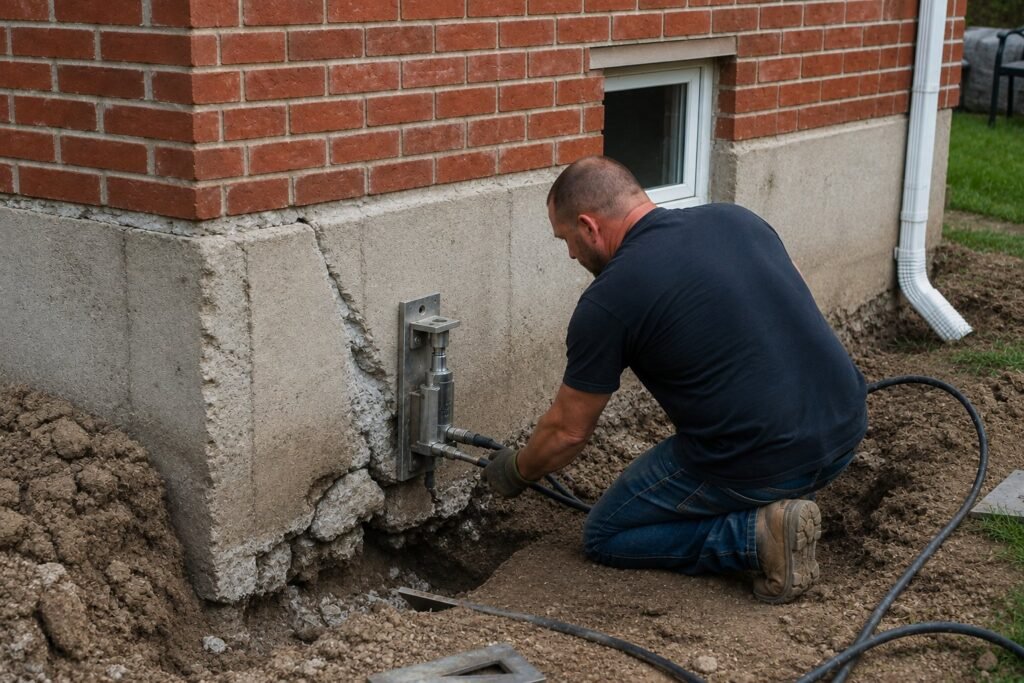
When part of a foundation drops, it is because the soil under the footing can no longer support the load, usually after that clay soil has dried out and shrunk, or was never compacted well when the house was built.
The fix is to transfer the weight of the house to stable soil or bedrock deeper down, using steel push piers or helical piers driven below the footing. In many cases the piers can also lift the foundation back toward its original position. We size and space the piers based on the load and the soil, not a template.
Bowing and leaning basement wall repair
A basement wall bows inward when the soil outside pushes harder than the wall can resist, usually from water-saturated clay and hydrostatic pressure, sometimes made worse by tree roots or heavy equipment near the foundation.
Depending on how far the wall has moved, the repair might be carbon fiber straps for smaller deflection, steel I-beams braced against the floor joists, or wall anchors that tie the wall back to stable soil in the yard. Catching it earlier means more options and lower cost.
Foundation repair options, in plain terms
There is no single “foundation repair.” The method depends on what the foundation is doing.
Steel push piers
Hydraulically driven steel piers that reach load-bearing soil deep below the house. Used for settlement on heavier structures. Can often lift the foundation back up.
Helical piers
Screw-in steel piers that work well for lighter loads and for new construction or additions. Installed with less vibration.
Carbon fiber straps
Bonded to a bowing wall to stop further inward movement. Best for walls that have moved a small amount and are not actively rotating.
Steel bracing and wall anchors
I-beams or anchor plates for walls that have moved further. Anchors can also straighten a wall over time as the soil is tightened.
Crack injection
Polyurethane or epoxy that fills a crack full-depth to stop water and, with epoxy, restore some strength to a non-moving crack.
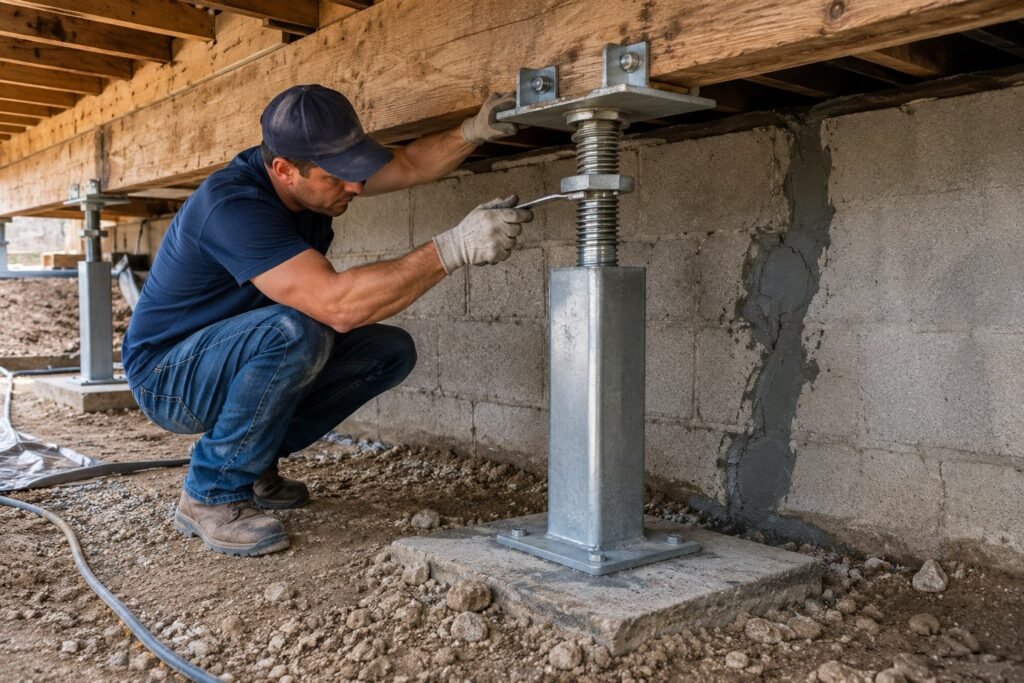
Crawl space supports
Adjustable steel posts and new beams or pads to re-support a crawl space that has settled and left the floor above it uneven.
What the inspection and repair process looks like
1. Book a visit
Call or send the form. We set a time and come out to look at the house.
2. On-site inspection
We check the foundation, basement or crawl space, drainage, and the doors and floors. We measure and document what we find.
3. Written plan and estimate
You get a clear explanation, the cause, the recommended repair, options, and a written price. No pressure to decide on the spot.
4. The repair
Our crew does the work, keeps you updated, and cleans up the site when the job is done.
What affects the cost of foundation repair
We do not publish flat prices because two houses with the same symptom can need very different work. The estimate you get is based on the actual foundation, not an average. These are the things that move the number:
- The repair method: crack injection is at the low end, a full row of piers or wall anchors is at the high end
- How many piers or anchors the foundation needs, and how deep the piers have to go to reach stable soil
- Access: an open yard is easier and cheaper to work in than a tight side yard with a deck and utilities
- Whether the foundation only needs to be stabilized, or also lifted back toward level
- Interior finishes that have to be removed and replaced to reach the wall
- Drainage or grading corrections done at the same time to keep the problem from returning
Minor crack sealing is often a few hundred dollars. Structural repairs with piers or anchors are commonly in the several-thousand to tens-of-thousands range depending on scope. The inspection is how you find out where your house falls.
Foundation repair questions homeowners ask
Is a crack in my foundation serious?
How do I know if my foundation is still moving?
Can foundation problems get worse if I wait?
How long does foundation repair take?
Do you offer free inspections?
Will my repair be warrantied?
Foundation repair across the Kansas side of the metro
We serve Kansas City, KS and the surrounding Kansas communities in Wyandotte, Johnson, and Leavenworth counties.
Talk to a foundation specialist today
Free inspection, written estimate, and a straight answer about what your foundation needs.