Home / Foundation Repair / Bowing Basement Wall Repair
Bowing Basement Wall Repair in Kansas City, KS
A basement wall that is bowing in, leaning at the top, or has a horizontal crack is being pushed by the soil outside. We stop the movement and, in many cases, straighten the wall back out over time.
How to tell a wall is bowing
Bowing usually happens in the lower-middle of a block wall, where the soil pressure is highest. Signs include:
- A horizontal crack running along the wall, often near the middle course of block
- The wall curving inward when you sight along it, or a gap behind a straightedge held against it
- The top of the wall tipping in, with a gap opening where it meets the sill plate
- Stair-step cracks at the corners where the bowing wall meets the end walls
- Bricks or blocks shifting or shearing along the mortar
- Doors in the basement that have gone out of square
A small amount of deflection, under an inch or so, usually has more repair options than a wall that has moved several inches, which is why it is worth checking early.
What pushes a basement wall in
Wet clay soil expands and presses on the wall. Add hydrostatic pressure from water that cannot drain, and the load can exceed what a block wall was built to hold. Downspouts dumping next to the house, a yard that slopes toward the foundation, and frost pressure in winter all make it worse.
Heavy vehicles or equipment parked near the foundation, and large tree roots, can add to the load.
How a bowing wall is repaired
The right method depends on how far the wall has moved and whether it is still moving. The goal is always the same: stop the inward movement and relieve or resist the pressure.
- Carbon fiber straps for walls with minor deflection that are not rotating
- Steel I-beams braced from the footing to the floor joists
- Wall anchors tied to steel plates set in stable soil out in the yard
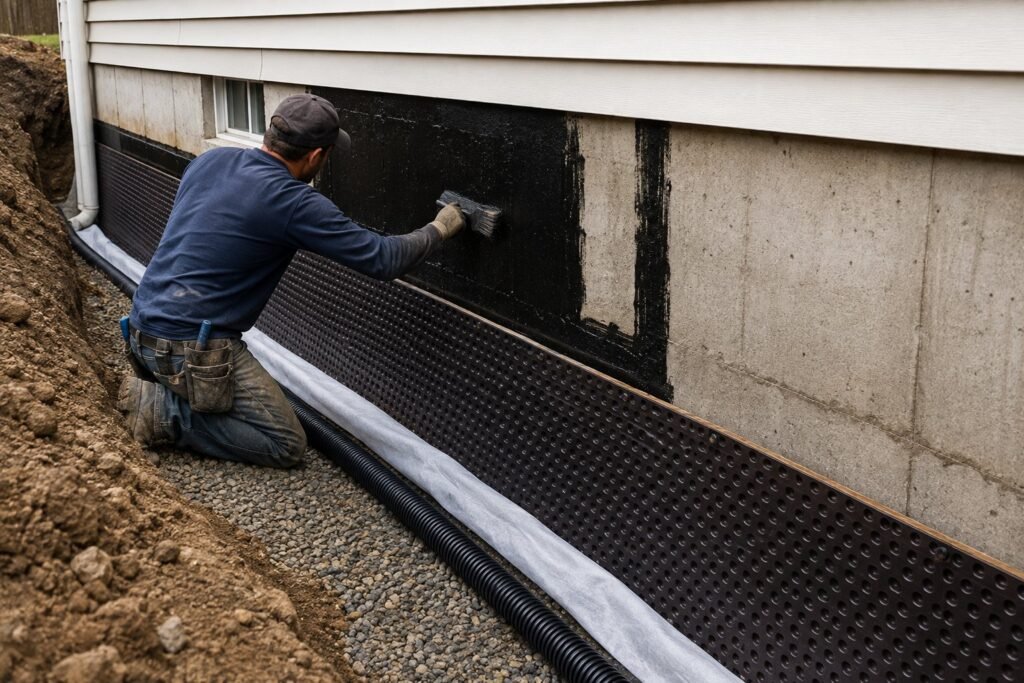
- Drainage work to relieve the water pressure that caused it
Bowing wall repair options
Carbon fiber straps
Strips of carbon fiber bonded floor-to-ceiling on the inside of the wall. Low-profile, no yard work. Best for walls that have bowed less than about two inches and are stable.
Steel I-beam bracing
Vertical steel beams anchored to the floor and the joists above. Holds the wall where it is and can be adjusted over time.
Wall anchors
Rods run from the wall to steel plates buried in the yard. Tightened over seasons, they can pull a wall back toward straight.
How the process works
1. Book a visit
Call or send the form and we set a time to come out.
2. Inspection
We measure how far the wall has moved, check if it is active, and look at the drainage that is loading it.
3. Written plan
A clear explanation, the recommended fix, options, and a written price. No pressure.
4. The work
Carbon fiber is often a one-day job. Beams and anchors take longer, especially if we are also correcting drainage outside.
What bowing wall repair costs
Cost is driven by the method and the number of support points along the wall:
- How many straps, beams, or anchors the wall needs
- Carbon fiber is usually the lowest-cost option; anchors and exterior work cost more
- Whether the wall only needs to be held or also straightened
- Excavation in the yard for anchors or exterior drainage
- Interior finishes that must be removed and replaced
Because early repairs have cheaper options, waiting on a bowing wall usually costs more later.
Common questions
How much can a basement wall bow before it is unsafe?
Can carbon fiber straps really hold a wall?
Will you be able to straighten my wall?
Do I need to fix the drainage too?
Is this covered by homeowners insurance?
Related services and reading
Serving Kansas City and the Kansas suburbs
We work throughout Kansas City, KS and the surrounding Kansas communities in Wyandotte, Johnson, and Leavenworth counties.
Get a bowing wall checked now
The earlier a leaning wall is looked at, the more repair options you have.